Our Sustainability Priorities, Defined by Evidence

In 2025, Gaasch Packaging completed its first Double Materiality Assessment. Here is what 2,172 stakeholder responses revealed about our responsibilities, our gaps, and our path forward.

We Asked. You Answered. Here Is What We Learned.

Gaasch Packaging has completed its first Double Materiality Assessment – a structured, stakeholder-driven analysis of the environmental, social and governance topics that matter most for our company and for the people around us.

This page shares the results. Not just the highlights, but also the areas where we know we need to do better. Because we believe that real progress starts with honesty about where we stand today.

We did not undertake this exercise to produce a glossy report. We did it to understand, with clarity and rigour, where our greatest impacts, risks and opportunities lie – and to build a credible roadmap from there.

How We Got Here

A Double Materiality Assessment looks at sustainability from two angles: how our business affects the world (impact materiality), and how environmental and social changes affect our business (financial materiality). This dual lens is at the heart of the EU’s Corporate Sustainability Reporting Directive (CSRD), and we embraced it as an opportunity to listen — truly listen — to the people who know our business best.

We started by identifying over 150 potential Impacts, Risks and Opportunities (IROs) across all our commercial and support activities, aligned with the 40 subtopics of the European Sustainability Reporting Standards (ESRS). AI-supported document analysis and internal reviews ensured we did not overlook what matters. For the final stakeholder analysis we kept the 52 most relevant topics.

Then we went to our stakeholders. Around 150 unique participants — employees, customers, suppliers, investors, management, board members and community representatives — scored and discussed these IROs through surveys, one-on-one interviews and facilitated focus groups. In total, 2,172 responses were collected.

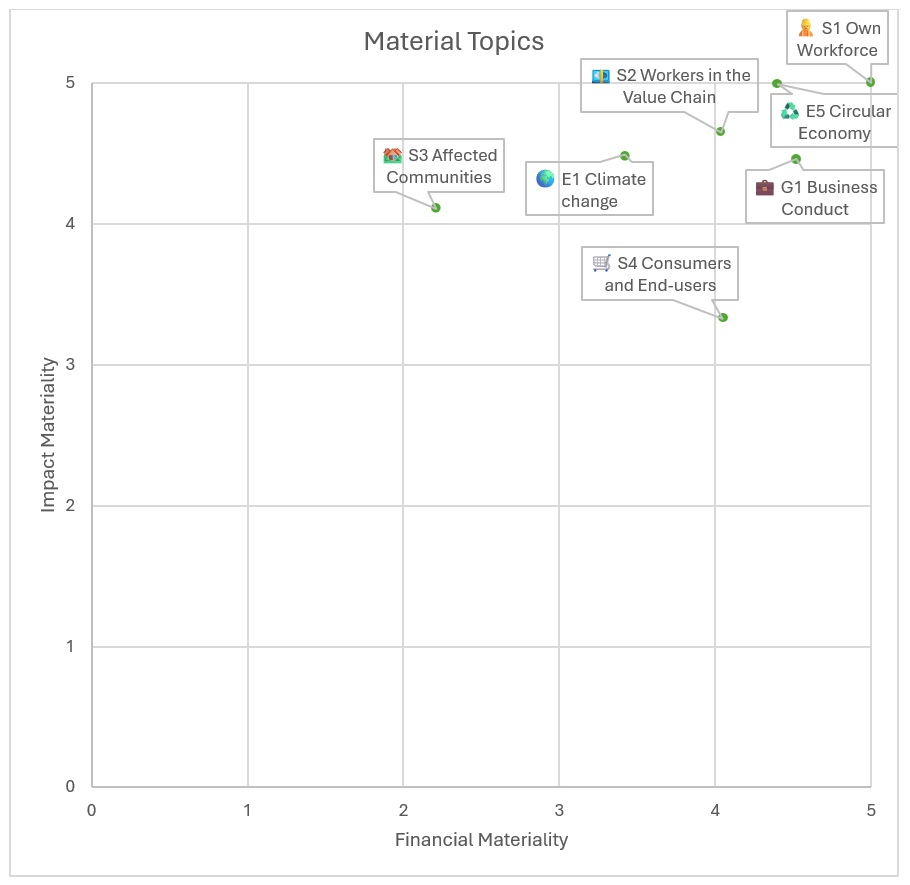
Responses were weighted by expertise, aggregated through a structured materiality model, and normalised to ensure fair comparison. The result is a materiality matrix that identifies the topics exceeding both our impact and financial materiality thresholds.

This was not a tick-box exercise. Stakeholders were actively encouraged to flag missing topics, challenge our assumptions, and tell us what they really think.

0
Stakeholders Engaged
0
Responses Collected
0
Material Themes Identified

The 7 Material Types

#

Theme

In one sentence

Link

1

fas fa-globe

ESRS E1.1 E1.2 E1.3

Our total footprint stands at 41,532 tonnes CO₂e — 96% of which sits upstream. We have cut direct emissions by 20% and committed to Science Based Targets (−42% Scope 1&2, −25% Scope 3 by 2030).

2

fas fa-recycle

ESRS E5.1 E5.2 E5.3

Our “Bring Back” take-back programme is live. Target: 30% of our range suitable for reuse by 2030. But the infrastructure and economics of circular packaging remain a work in progress.

3

fas fa-scale-balanced

ESRS S1.1 S1.2 S1.3

Rights, well-being and fair working conditions. ISO 45001 aligned. The 2025 engagement survey showed only 39% rate internal communication positively.

4

fas fa-people-group

ESRS S2.1 S2.2 S2.3

Stakeholders flagged concerns about working conditions and treatment of workers at supplier level. Visibility into the deeper supply chain needs to improve.

5

fas fa-handshake-simple

ESRS S3.1

A family business with deep local roots. AMAB partnership for social inclusion. Stakeholders want more visibility on community initiatives and honest acknowledgement of environmental externalities.

6

fas fa-shield-halved

ESRS S4.1 S4.2

Reliable, quality products for regulated markets. But our approach to consumer safety is more reactive than proactive, and demand for sustainability data from end-users is intensifying.

7

fas fa-truck-fast

ESRS G1.1 G1.5 G1.6

Our Supplier Code of Conduct sets clear expectations, but monitoring and enforcement are not yet systematic. The next step is moving from trust-based to evidence-based supplier assessment.

The 7 Material Themes

fas fa-globe

Climate Change

ESRS

Our total footprint stands at 41,532 tonnes CO₂e — 96% of which sits upstream. We have cut direct emissions by 20% and committed to Science Based Targets (−42% Scope 1&2, −25% Scope 3 by 2030).

fas fa-recycle

Circular Economy

ESRS

Our “Bring Back” take-back programme is live. Target: 30% of our range suitable for reuse by 2030. But the infrastructure and economics of circular packaging remain a work in progress.

fas fa-people-carry-box

Own Workforce

ESRS

EcoVadis Bronze certified — but our ethics policy was flagged as “Low.” Anti-corruption training, external endorsements and better internal communication of our values are priorities.

fas fa-people-group

Workers in the Value Chain

ESRS

Rights, well-being and fair working conditions. ISO 45001 aligned. The 2025 engagement survey showed only 39% rate internal communication positively.

Inclusion, diversity and equal opportunity. Gender diversity in leadership was identified as a gap. Structured development pathways are being built.

Regular investment in warehouse safety equipment and PPE. Only 33% of staff perceive career opportunities positively — career pathways need to be more visible.

fas fa-house-chimney

Affected Communities

ESRS S2

Our Supplier Code of Conduct sets clear expectations, but monitoring and enforcement are not yet systematic. The next step is moving from trust-based to evidence-based supplier assessment.

fas fa-box

Consumers & End-Users

ESRS

Stakeholders flagged concerns about working conditions and treatment of workers at supplier level. Visibility into the deeper supply chain needs to improve.

fas fa-scale-balanced

Business Conduct

ESRS

A family business with deep local roots. AMAB partnership for social inclusion. Stakeholders want more visibility on community initiatives and honest acknowledgement of environmental externalities.

What We Found: 7 Material Topics

Seven topics emerged as material for Gaasch Packaging – meaning they cross the threshold for both our impact on the world and the financial significance for our business. Together, they form the backbone of our future ESG strategy and reporting. Below, we share what each topic means for us, what we have already done, and – just as importantly – where we still fall short.

1 Climate Change

Climate change sits at the centre of our materiality matrix, and for good reason. As a packaging distributor, our direct operations – warehouses, offices, a small fleet – account for a modest share of greenhouse gas emissions. But our value chain tells a very different story.

Our 2024 GHG inventory puts total emissions at 41,532 tonnes of CO₂ equivalent. Of that, 96% comes from upstream activities: the energy-intensive production of glass, plastics and other materials by our suppliers, and the transportation that brings them to us. This is our Scope 3 reality, and we are not looking away from it.

On the operational side, we have made tangible progress. Solar panels on our facilities, heat pumps, and the electrification of our vehicle fleet have delivered a 20% reduction in our direct carbon footprint. These are genuine investments, not gestures – something our stakeholders recognised and appreciated during the assessment.

Looking ahead, we have committed to Science Based Targets: a 42% reduction in Scope 1 and 2 emissions and a 25% reduction in Scope 3 emissions by 2030. Reaching the Scope 3 target will require deeper supplier partnerships, better data visibility across the chain, and honest conversations about what is achievable. We are at the beginning of that work, not the end.

What We Have Done

What We Still Need To Do

  • 20% reduction in direct carbon footprint
  • Deepen Scope 3 supplier engagement (96% of emissions)
  • Solar panles and heat pumps installed
  • Improve value chain data visibility
  • Vehicle fleet electrification underway
  • Translate SBTi commitments into operational milestones
  • Science based targets approved

2 Circular Economy

If there is one area where ambition meets complexity head-on, it is the circular economy. Our stakeholders see the opportunity clearly — take-back schemes, reusable packaging, recycled materials — but they also see the obstacles: infrastructure gaps, challenging economics, and the slow pace of systemic change.

We have started. Our “Bring Back” take-back programme is live, beginning in the beer sector where reuse logistics are most established. We are increasing the share of recycled glass in our product range, and we actively advise customers on packaging choices that support their own circularity and recycling targets. The shift towards mono-material packaging solutions is helping customers simplify their recycling streams.

Our target is ambitious: 30% of our product range suitable for reuse by 2030. We are transparent about the fact that we are in the early stages. The infrastructure for circular systems is not yet where it needs to be. The economics of refill packaging remain challenging, particularly when consumers purchase less frequently. And changing behaviour — both in business and among end-users — takes patience.

What the DMA confirmed is that circular economy is not just an environmental topic for Gaasch. It is a financial one. Aligning with circular economy legislation is crucial for maintaining market relevance. Customers increasingly expect it. And the companies that build circular capabilities now will be better positioned when the regulatory and market landscape shifts further.

What We Have Done

What We Still Need To Do

  • "Bring Back" take-back programme launched (beer sector)
  • Build reuse infrastructure towards 30% target by 2030
  • Increasing recycled glass in product portfolio
  • Address logistical economics of circular transition
  • Shift towards mono-material solutions
  • Expand circular initiatives beyond beer sector
  • Advisory role on sustainable packaging choices
  • Develope revenue model around advisory and take-back services

3 Own Workforce

Our people are the heart of this company, and the DMA made that clear in ways that went beyond what we expected.

On safety, the picture is encouraging. Gaasch Packaging is aligned with ISO 45001 for occupational health and safety. We invest regularly in warehouse equipment, personal protective gear, and emergency preparedness. Our stakeholders — employees and management alike — recognise these efforts and consider our safety culture to be strong.

But the assessment also surfaced challenges we need to face. Internal communication was consistently identified as an area for improvement. While progress has been made, stakeholders told us that employees do not always feel heard, that information does not always flow as it should, and that managers could be better equipped to act as communication bridges. The 2025 employee engagement survey confirmed this: only 39% of employees perceive open communication positively.

Career development is another area where we heard a clear message. With a flat organisational structure and a relatively small team, career pathways are not always visible. Only 33% of staff perceive career opportunities positively. We know this affects retention and satisfaction, and we are working to create more structured development and learning paths.

Diversity in leadership was flagged as a gap. With limited gender diversity in the management team and challenges in attracting diverse talent, there is work to do to make our workforce reflect the breadth of perspectives we need. Flexible working arrangements and wellness initiatives are in place, but they are foundations, not solutions.

What We Have Done

What We Still Need To Do

  • ISO 45001 aligned health and safety management
  • Strengthen internal communication – train managers as communication champions
  • Regular investment in safety equipment and warehouse infrastructure
  • Create visible and structured career developement pathways
  • Flexible working and wellness initiatives
  • Improve gernder diversity in leadership
  • Employee engagement survey conducted (2025)
  • Act on employee engagement survey findings systematically

4 Workers in the Value Chain

Gaasch Packaging’s Supplier Code of Conduct sets clear expectations: no child or forced labour, fair wages, freedom of association, and safe working conditions. These principles are non-negotiable, and they apply across our entire supplier base.

But our DMA revealed a tension between intention and execution. While we have the right policies in place, stakeholders — including our own management — acknowledged that monitoring and enforcement are not yet systematic. We rely significantly on trust, long-standing relationships, and the assumption that European suppliers operate within established regulatory frameworks. Our stakeholders told us that assumption, while often valid, can be dangerous.

Extended stakeholders suggested that non-compliant suppliers should be given the opportunity to improve, but that ultimately, relationships with those who fail to meet standards should be terminated. Employees and direct suppliers indicated difficulty in assessing fair labour practices due to limited visibility into the deeper supply chain.

We hear this feedback. The next step is to formalise our monitoring processes, integrate labour and safety criteria more systematically into supplier evaluations, and move beyond personal initiatives toward structured due diligence. Our Corporate Code of Conduct provides for training, audits, and grievance mechanisms — the framework exists. What needs to improve is the consistency and rigour with which we apply it.

What We Have Done

What We Still Need To Do

  • Supplier Code of Conduct with clear labour standards
  • Systematise supplier monitoring and compliance checks
  • Corporate Code of Conduct extending to supply chain
  • Formalise due diligence processes across the value chain
  • Long-term supplier relationships built on trust
  • Move beyond trust-based to evidence-based supplier assessment
  • Mechanisms for training, audits and grievance in place
  • Improve visibility into deeper supply chain practices

5 Affected Communities

Gaasch Packaging is a family business with deep roots in its region. Stakeholders rate our local contribution highly — scores of 3 and 4 out of 5 — reflecting a positive engagement that has grown over generations.

Our partnership with AMAB, which provides employment opportunities for individuals distant from the labour market, is a concrete example of how we contribute to social inclusion and local economic rights. Management and focus groups recognised this work as meaningful and well-aligned with our values.

At the same time, stakeholders told us they would like to see more. Employees suggested organising sustainability education events for the wider community. Suppliers found it challenging to evaluate our community impact due to limited communication about what we do locally.

There is also an honest tension to acknowledge: while our social contributions are appreciated, our packaging activities do generate environmental externalities — emissions, waste, transport — that affect local residents. Ignoring that reality would undermine the very transparency we are trying to build. Strong community relationships provide a social licence to operate, but that licence must be earned continuously, not assumed.

What We Have Done

What We Still Need To Do

  • Partnership with AMAB for social inclusion
  • Expand community interaction – consider sustainability education events
  • Generational community engagement and regional anchoring
  • Communicate local initiatives more visibly
  • Collaboration with local enterprises
  • Address environmental externalities affecting local residents
  • Rainwater harvesting initiative benefiting local farmer
  • Develop a community engagement strategy with measurable goals

6 Consumers & End-Users

Here is a reality we must reckon with: most end consumers have never heard of Gaasch Packaging. Our impact on consumers is indirect, mediated through the brands and businesses we supply. And yet, the choices we make about materials, safety, and transparency ripple through to every person who picks up a bottle, opens a jar, or applies a product from a container we distributed.

Our assessment identified two dimensions of materiality here. First, there is the question of product safety. We have consumer-protection features in place — child-safe caps, compliance with food and pharmaceutical regulations, formal recall procedures and insurance coverage. But our approach to consumer feedback has been more reactive than proactive. The lack of systematic monitoring means emerging hazards, particularly around microplastics, could go undetected.

Second, there is the question of transparency. Our stakeholders — both direct customers and extended participants — told us that the demand for product information and sustainability data is intensifying. Proactive transparency can build customer loyalty, enable higher-margin sustainable solutions, and strengthen trust in environmentally conscious market segments.

We position ourselves as specialists in secure, compliant packaging for regulated markets. That positioning carries responsibility. We need to evolve from reactive compliance to proactive stewardship — improving monitoring, enhancing product information, and helping our customers communicate sustainability credibly to their own consumers.

What We Have Done

What We Still Need To Do

  • Consumer-protection features (child-safe caps, regulatory compliance)
  • Shift from reactive to proactive consumer safety monitoring
  • Formal recall procedures and insurance coverage
  • Improve transparency and product sustainability information
  • GDPR-compliant data protection
  • Help customers communicate sustainability to end-users
  • Specialist positioning in regulated markets (pharma, food)
  • Address emerging microplastic-related hazards systematically

7 Business Conduct

This is the topic where we are most candid about the gap between where we are and where we need to be.

Gaasch Packaging has a Corporate Code of Ethics that explicitly prohibits bribery and corruption, requires transparency in business dealings, and includes specific approval procedures for sensitive transactions. We have a Supplier Code of Conduct that integrates ethical standards. And we earned our EcoVadis Bronze certification – a recognition that foundational practices are in place.

But EcoVadis also flagged our ethics policy status as “Low.” The assessment identified the absence of external initiative endorsements, the lack of quantitative anti-corruption targets, and insufficient employee training on ethical risks. These are not minor gaps. They are areas that need structured, measurable action.

Our stakeholders echoed this assessment. Extended stakeholders and focus groups viewed our ethical charter and code of conduct as important but insufficient on their own. They stressed the need for active implementation and employee engagement – not just documents, but lived practices. Some customers and suppliers were not even aware these documents existed, which tells us something about how well we communicate our commitments.

Corporate culture is part of this picture. Our family-driven values are genuine, but the 2025 employee engagement survey showed that open communication is perceived positively by only 39% of employees, and career opportunities by only 33%. A culture that intends to be inclusive and transparent must work to make sure that intention is felt by everyone, every day.

We are proud of EcoVadis Bronze. It tells us the foundations are solid. But we are clear-eyed about what it does not yet cover. In the coming months, we will work on documented risk assessments, formal anti-corruption training, external initiative endorsements, and a communication strategy that makes our ethical commitments visible and actionable – internally and externally.

What We Have Done

What We Still Need To Do

  • Corporate Code of Ethics in place
  • Develop quantitative anti-corruption targets
  • Supplier Code of Conduct with ethical standards
  • Implement formal anti-corruption training programme
  • EcoVadis Bronze certification achieved
  • Secure external initiative endorsements
  • Sustainability Coordinator hired
  • Improve internal communication of ethical commitments

  • Address employee engagement gaps (communication, career)

The Path Ahead

We are not publishing this assessment because everything is in order. We are publishing it because we believe transparency — even when it reveals uncomfortable truths — is the only credible foundation for progress.

Our EcoVadis Bronze certification is a milestone we are proud of. It tells us that the basics are in place: a code of ethics, safety standards, environmental initiatives, community engagement. But it also tells us how much further we need to go.

In the coming months, we will translate the DMA findings into a concrete ESG action plan. That means setting measurable targets for each material topic. Defining KPIs that we will report on publicly. Building the internal capabilities and external partnerships needed to deliver on our commitments.

Some of this work will be visible quickly. Other parts will take years. We are prepared for both.

What we will not do is wait for perfection before we communicate. The stakeholders who gave their time and honesty to this process deserve to see what we do with their input. And the customers, suppliers and communities we work with deserve to know where we stand — warts and all.

The journey is long. But the path has been lit. And we are walking it with our eyes open.

Image

Download the Full DMA Report

Contact Us to Discuss