We Asked. You Answered. Here Is What We Learned.
Gaasch Packaging has completed its first Double Materiality Assessment – a structured, stakeholder-driven analysis of the environmental, social and governance topics that matter most for our company and for the people around us.
This page shares the results. Not just the highlights, but also the areas where we know we need to do better. Because we believe that real progress starts with honesty about where we stand today.
We did not undertake this exercise to produce a glossy report. We did it to understand, with clarity and rigour, where our greatest impacts, risks and opportunities lie – and to build a credible roadmap from there.
How We Got Here
A Double Materiality Assessment looks at sustainability from two angles: how our business affects the world (impact materiality), and how environmental and social changes affect our business (financial materiality). This dual lens is at the heart of the EU’s Corporate Sustainability Reporting Directive (CSRD), and we embraced it as an opportunity to listen — truly listen — to the people who know our business best.
We started by identifying over 150 potential Impacts, Risks and Opportunities (IROs) across all our commercial and support activities, aligned with the 40 subtopics of the European Sustainability Reporting Standards (ESRS). AI-supported document analysis and internal reviews ensured we did not overlook what matters. For the final stakeholder analysis we kept the 52 most relevant topics.
Then we went to our stakeholders. Around 150 unique participants — employees, customers, suppliers, investors, management, board members and community representatives — scored and discussed these IROs through surveys, one-on-one interviews and facilitated focus groups. In total, 2,172 responses were collected.
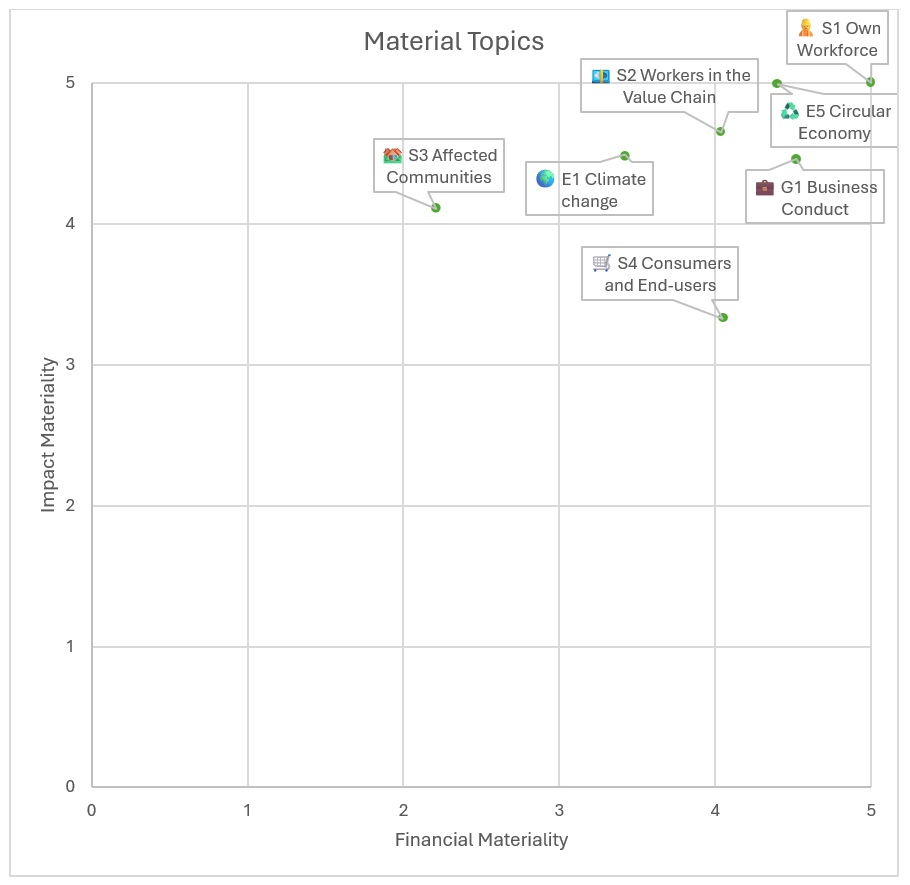
Responses were weighted by expertise, aggregated through a structured materiality model, and normalised to ensure fair comparison. The result is a materiality matrix that identifies the topics exceeding both our impact and financial materiality thresholds.
This was not a tick-box exercise. Stakeholders were actively encouraged to flag missing topics, challenge our assumptions, and tell us what they really think.
What We Found
The outcome shows that own workforce, circular economy, business conduct, climate change, value chain cooperation, communities and end-users are our most material sustainability matters.
These findings reflect the lived reality of our business – shaped not by internal assumptions, but by the voices of the people who work with us, for us, and alongside us every day.
Each of the 7 material topics – spanning 14 subtopics in total – carries its own weight and will be treated with the dedicated attention it deserves. From workforce wellbeing to corruption prevention, from circular packaging to climate adaptation: every topic has its own context, its own stakeholders, and its own path forward. What this process confirmed above all is that our stakeholders are ready for more. More transparency, more ambition, more accountability. That is not a burden, it is an invitation, and we are taking it seriously.

Material Types
| Subtopics | IROs for Gaasch Packaging | ESG Strategy | ||
|---|---|---|---|---|
| Climate Change | E1.1 | GHC Emissions | Electrification and solar integration for emission reduction |
|
| Energy optimization for cost reduction | ||||
| E1.2 | Climate change adaptation | Sustainable packaging solutions | ||
| Financial exposure to weather extremes | ||||
| Circular Economy | E5.1 | Resource inflows and use | Increased use of recycled glass |
|
| Revenue from reusable packaging | ||||
| E5.2 | Resource outflows related to products and services | Enhanced circular packaging system | ||
| Single-use disposal of packaging | ||||
| Logistical costs from circular transition | ||||
| Leveraging circular packaging for competitive advantage | ||||
| Own Workforce | S1.1 | Working conditions | Enhanced safety measures for own workforce |
|
| Enhanced professional development and equal opportunity | ||||
| Communication gaps leading to employee discontent | ||||
| Optimized workforce safety and efficiency | ||||
| Reintegration of long-term sick employees | ||||
| S1.2 | Equal treatment and opportunity for all | Transparent and equitable hiring practices | ||
| Diversity-driven talent attraction | ||||
| S1.3 | Other work related rights | Empowered workforce through open communication | ||
| Career development and lifelong learning | ||||
| Workers in the Value Chain | S2.1 | Working conditions | Ensuring fair compensation in the value chain |
|
| Ethical supplier relationships | ||||
| S2.2 | Equal treatment and opportunity for all | Implementing non-discrimination policies | ||
| Potential liability from discrimination in supply chain | ||||
| Affected Communities | S3.1 | Communities economic, social and cultural rights | Economic empowerment through local employment |
|
| Enhanced market access through community engagement | ||||
| Consumers & End-Users | S4.2 | Person safety of consumers and end-users | Microplastic release from packaging |
|
| Reputational damage from quality and safety concerns | ||||
| Business Conduct | G1.1 | Corporate culture | Ethical charter enhances corporate culture |
|
| Enhanced talent attraction through inclusive corporate culture | ||||
| G1.5 | Management of relationships with suppliers incl. payment practices | Supplier relationship and payment management risks | ||
| Enhanced supplier relationships through fair payment practices | ||||
| G1.6 | Corruption and bribery prevention, detection, training and incidents | Corruption prevention through employee awareness | ||
| Potential corruption and bribery risks | ||||
| Strengthened stakeholder trust through anti-corruption policies |
The Path Ahead
We are not publishing this assessment because everything is in order. We are publishing it because we believe transparency — even when it reveals uncomfortable truths — is the only credible foundation for progress.
In the coming months, we will translate the DMA findings into a concrete ESG action plan. That means setting measurable targets for each material topic. Defining KPIs that we will report on publicly. Building the internal capabilities and external partnerships needed to deliver on our commitments.
Some of this work will be visible quickly. Other parts will take years. We are prepared for both.
What we will not do is wait for perfection before we communicate. The stakeholders who gave their time and honesty to this process deserve to see what we do with their input. And the customers, suppliers and communities we work with deserve to know where we stand – warts and all.
The journey is long. But the path has been lit. And we are walking it with our eyes open.

Contact Us to Discuss
All reports, certificates and verification documents supporting these claims are available under gaaschpack.eu/downloads.