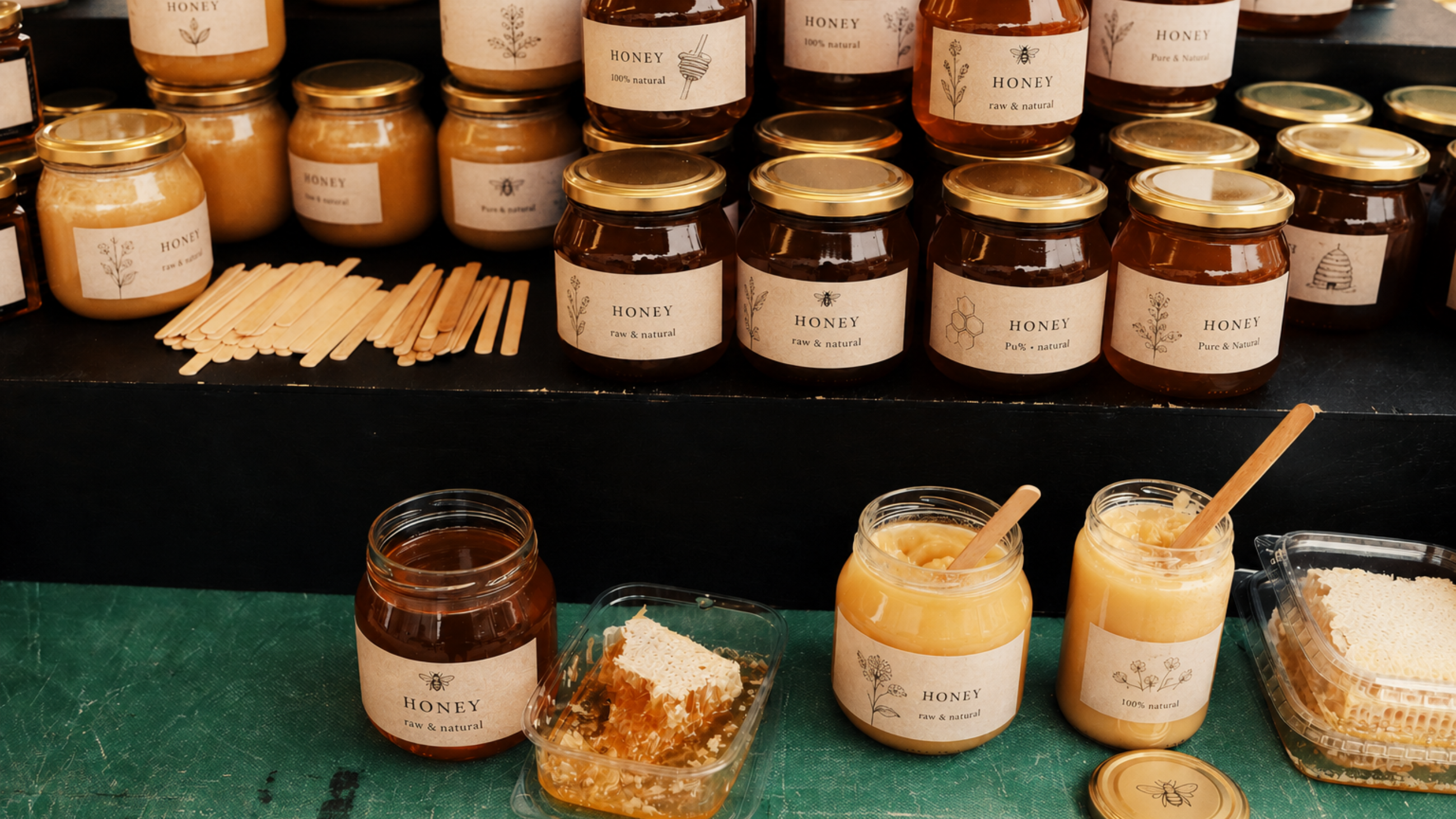
Glass jars for food producers: food-grade quality, scalable supply and private-label decoration
For the food industry, glass jars are more than packaging — they are a technical component of your production line and your brand's calling card on the shelf. This guide sets out, for purchasers, COOs and brand managers, what counts when choosing a glass container: food-grade quality, compatible closures, PPWR compliance and the options for private-label decoration.
Which glass is food-grade and why is it the baseline choice for every food producer?
Food-grade glass is a specific product category in which the chemical inertness of the material is laid down by law. Glass packaging for direct food contact must comply with Regulation (EC) No 1935/2004 on materials and articles intended to come into contact with food. That is not a matter of choice. It is the legal basis for any food producer wishing to bring their product to the European market.
But the baseline choice goes beyond compliance alone. Glass does not react with acidic products such as pickles, tomato sauce or jam. It does not absorb odours. It allows no migration of chemical substances into the product. That is precisely why food producers — from premium sauces to large private-label jam brands — consistently choose glass, even when alternatives such as PET or PP appear cheaper at first glance.
What many purchasers only discover well into a product launch: not all glass is equal. The quality of the glass — wall thickness, uniformity, thermal resistance, the absence of inclusions or air bubbles — determines how your jars behave on the filling line. A jar that breaks during pasteurisation, or that has uneven sealing surfaces causing your capping line to stall, costs you far more than the price difference per unit.
Quality control therefore begins with the supplier's specifications, not with your own incoming inspection. Always ask for technical product sheets with dimensional tolerances, thermal shock resistance and declarations of compliance for food contact. Suppliers who do not provide these as standard are a risk to your production continuity.
For SMEs exporting to several countries — Belgium, the Netherlands, Germany, France — the documentation around food-grade packaging is moreover a recurring audit point. A single supplier who provides correct compliance documents for all markets saves your quality department a considerable amount of work.
What distinguishes food-grade glass in practice
- Regulation (EC) No 1935/2004: legal basis for all food contact packaging in Europe.
- Glass is chemically inert: no migration, no odour absorption, no reaction with acidic products.
- Wall thickness and uniformity determine performance on the filling line — not just visual quality.
- Thermal resistance is critical in pasteurisation and hot-fill processes.
- Declarations of Compliance are mandatory for export to all EU markets.
- Technical product sheets with dimensional tolerances are a minimum requirement when selecting a glass supplier.
|
Property |
Glass |
PET |
PP |
|
Chemical inertness |
Fully inert |
Limited (acids, fats) |
Limited (aroma absorption possible) |
|
EU food contact compliance |
Yes (Reg. 1935/2004) |
Yes, but migration limits apply |
Yes, but migration limits apply |
|
Pasteurisation compatible |
Yes |
No (standard PET) |
Limited |
|
Reusable / recyclable |
Yes, infinitely recyclable |
Limited |
Limited |
|
Premium brand experience |
High |
Average |
Low to average |
|
Breakage risk on filling line |
Present with poor quality |
No breakage |
No breakage |
Comparison of glass, PET and PP for food packaging.
The glass that saves money on your filling line costs you double at the first audit failure or line stop.
Closure systems for glass jars: twist-off, lug cap or another seal — which one fits your production line?
Every filling line is different. That sounds obvious, but it is precisely why the choice of a closure system goes wrong more often than production managers expect. A twist-off cap works excellently for jam or pesto. But that same closure can let air through on a line that is not calibrated for the correct torque — and you will only discover that after the best-before complaint from your retail customer.
The three most commonly used systems for glass jars in the food industry are twist-off (TO), lug cap and deep-skirt. Each system has its own sealing geometry, its own torque range and its own vacuum requirement. The choice depends on four factors: the product itself (viscosity, acidity, fill temperature), the filling process (cold fill, hot fill, pasteurisation), the desired opening force for the end user, and the speed of your line.
A lug cap — also known as a bayonet closure — closes faster than a twist-off and is popular at higher line speeds. But lug caps require more precise jar positioning on the line. For SMEs with semi-automatic filling lines, that can lead to increased rejects.
What many purchasers also underestimate: the jar–lid combination is a system, not the sum of two separate SKUs. The height of the finish (the rim of the jar), the flatness of the sealing surface, the coating on the lid — these must be matched to each other. A lid from supplier A does not always perform optimally on a jar from supplier B, even if they nominally share the same format.
Gaasch Packaging supplies jars and matching closures as a coordinated system. That means you do not have to test compatibility yourself, and the validation of your filling line proceeds significantly faster.
Comparison of the main closures
- Twist-off (TO): suitable for jam, sauces, vegetables — widely available, straightforward on standard lines.
- Lug cap: higher line speeds possible, but requires precise jar positioning.
- Deep-skirt / Press-on: applicable for specific product formats or aesthetic requirements.
- Torque and vacuum values are line-specific — always validate before serial production.
- Lid and jar form one system: finish geometry and coating type must be matched.
- Hot-fill and pasteurisation place additional demands on the thermal resistance of the lid.
|
Closure system |
Application |
Line speed |
Vacuum required |
Points of attention |
|
Twist-off (TO) |
Jam, sauce, honey, vegetables |
Low to medium-high |
Yes |
Torque calibration is critical |
|
Lug cap |
Vegetables, sauces, preserves |
Medium-high to high |
Yes |
Jar positioning on the line |
|
Deep-skirt / Press-on |
Niche applications, premium segment |
Low to medium-high |
Depending on application |
Less universally available |
|
Continuous thread cap |
Dry products, spices, coffee |
Low to medium-high |
No or optional |
Not suitable for preserves |
Overview of closure systems for glass jars and their application area.
The closure is the weakest point in your packaging — until you have validated it correctly on your own line.
PPWR regulation and food safety: what does this mean in practice for your glass food packaging?
The Packaging and Packaging Waste Regulation — PPWR for short — is the revised European regulation that replaces and tightens the rules around packaging design, recycling and reuse compared with the earlier Directive 94/62/EC. It has entered into force and is being applied in phases. In practice, this means: if you are designing or purchasing packaging today for products that will still be on the market two or three years from now, you are buying under regulation you already need to know.
For food producers using glass jars, there are three direct points of contact with the PPWR. First: minimum recycled content requirements. For glass packaging, minimum percentages of recycled glass become mandatory, increasing over time. Second: the labelling and information requirements on the packaging itself, which must be in line with European rules. Third: the rules on unnecessary packaging layers and minimisation — an aspect that also affects your primary packaging if there is overcapacity in the packaging dimensions.
What this means for you as a purchaser or COO: every new packaging choice calls for a brief PPWR check. Not as a bureaucratic exercise, but as risk management. Packaging that has the lowest purchase price today but tomorrow fails to meet recycling requirements generates compliance costs and reputational risks with your retail partners.
In addition, food safety remains a parallel obligation. Regulation (EC) No 1935/2004 and the specific directives for food contact materials continue to apply alongside the PPWR. The two regulatory frameworks overlap, but are not identical. Your supplier must be able to support both.
Gaasch Packaging has an integrated quality and sustainability service that supports clients with PPWR compliance and food contact requirements. This includes providing the correct documentation per market — relevant for producers exporting to Belgium, the Netherlands, Germany, France and the United Kingdom.
The main PPWR impact points at a glance
- PPWR replaces Directive 94/62/EC and sets stricter requirements for recycling, reuse and recycled content.
- Minimum recycled content requirements for glass become mandatory in phases — relevant at every new packaging choice.
- Labelling and information requirements on packaging are expanded under PPWR.
- Food safety obligations (Reg. 1935/2004) run parallel to PPWR — both frameworks apply.
- Export to several EU countries requires market-specific compliance documentation.
- Integrating PPWR early into packaging design avoids costly adjustments later.
|
Regulation |
Scope of application |
Relevant for glass jars |
Documentation required |
|
Regulation (EC) 1935/2004 |
Materials in contact with food |
Yes — mandatory for all food contact packaging |
Declaration of Compliance (DoC) |
|
PPWR (revised packaging regulation) |
Packaging design, recycling, recycled content, reuse |
Yes — recycled content, minimum requirements, labelling |
Technical dossier, material declarations |
|
Directive 94/62/EC (former framework) |
Packaging and packaging waste |
Being replaced by PPWR |
Expired / in transition |
|
National transposition legislation (BE, NL, DE, FR, UK) |
Country-specific implementation of EU rules |
Yes — relevant for export |
Market-specific compliance documents |
The four regulatory frameworks that affect your glass food packaging.
Packaging that is compliant today but not tomorrow is no cost saving — it is a deferred compliance problem.
Private-label decoration for glass jars: from printing to sleeve and personalised honey jars or sauces
Private label in the food sector is no longer a niche. Retailers demand it, foodservice companies want it, and even mid-sized producers are building their own brands alongside their private-label activities. Packaging is no afterthought in this. It is the first — and sometimes only — contact a consumer has with your brand on the shelf.
For glass jars — honey jars, sauce bottles, jam jars, herbal tea preparations — there are four common decoration methods. Each has its own minimum order quantity, its own lead time and its own visual result. The choice depends on your volume, your brand positioning and your production planning.
Direct printing on glass (ceramic inks, fired in the oven) gives a premium, permanent result without a label. Suited to volumes where the extra investment per unit is recouped through brand value. Sleeves — shrink films applied around the jar — are more flexible in terms of minimum order quantity and lend themselves well to seasonal variants or limited editions. Self-adhesive labels remain the most common and cost-efficient method for SMEs managing multiple SKUs with variable volumes.
Engraving and lacquering are more specialised techniques, particularly for premium positioning in the honey or specialty segment. An engraved honey jar communicates craftsmanship in a way that a paper label cannot match.
What purchasers and brand managers run into in practice: the coordination between packaging supplier and printer is time-consuming. Colour profiles that do not match, sleeves that do not seal correctly on a specific shoulder geometry, labels that peel off due to condensation on the cold jar wall — these are real production problems that slow your time-to-market.
Gaasch Packaging offers decoration and personalisation services as an integrated service: printing, sleeving, engraving and lacquering are coordinated from a single point of contact. That eliminates the coordination load between your purchasing department and external suppliers, and shortens the lead time from design to labelled jar on your filling line.
The four main methods at a glance
- Direct glass printing (ceramic inks): permanent, label-free, premium positioning — higher MOQ.
- Shrink-film sleeve: flexible MOQ, suited to seasonal editions and several SKUs on the same jar.
- Self-adhesive label: most common method, lowest entry threshold, wide range of materials.
- Engraving: craft-style premium effect, particularly for honey, specialties and gift packs.
- Lacquering: decorative colour layer on the glass itself, without a label — suited to specific brand identities.
- Integrating packaging and decoration via a single supplier shortens lead time and avoids coordination errors.
|
Decoration method |
Visual effect |
Minimum run (indicative) |
SKU variant flexibility |
Suitable for |
|
Direct glass printing |
Premium, permanent, label-free |
High (custom) |
Low |
Fixed brand packaging, high volume |
|
Shrink-film sleeve |
360° decoration, full colour |
Medium |
High |
Seasonal editions, private label, multiple SKUs |
|
Self-adhesive label |
Broadly applicable |
Low |
Very high |
SMEs, variable volume, test launch |
|
Engraving |
Relief, craft-style, exclusive |
Low to medium |
Limited |
Premium honey, specialties, gift packs |
|
Lacquering |
Colour layer on glass |
Medium to high |
Limited |
Strong brand identity, premium segment |
The five decoration methods for glass jars, compared on MOQ, flexibility and visual effect.
Your honey jar or sauce bottle is a billboard on the shelf — the decoration decides whether the consumer picks up or passes by.
Ready to optimise your packaging?
Looking for a supplier that delivers glass jars, matching closures and private-label decoration as an integrated system — with correct compliance documentation for your export markets? Contact Gaasch Packaging for a conversation without sales pressure. We map your current packaging situation and advise based on your volume, your line and your markets.
Frequently asked questions
1. What does food-grade mean for glass jars and which documents do you need as a food producer?
Food-grade means that the glass complies with Regulation (EC) No 1935/2004, which requires chemical inertness and the absence of migration into food. As a food producer, you need at minimum a Declaration of Compliance (DoC) from your packaging supplier. When exporting to several EU countries — such as Belgium, the Netherlands, Germany or France — additional market-specific documents may be required. Always ask proactively for the technical product sheet with dimensional tolerances and the declaration of compliance for food contact.
2. Which closure system is best suited to a hot-fill or pasteurisation process?
In hot-fill and pasteurisation, the thermal resistance of both the glass and the lid is decisive. Twist-off lids are widely proven for these processes, provided the torque is correctly calibrated on your filling line and the lid has a coating that withstands the process temperature. Lug caps are an alternative at higher line speeds. Validation of the jar–lid system on your own line remains essential before serial production.
3. What concretely changes under PPWR for producers using glass food packaging?
PPWR introduces, among other things, mandatory minimum recycled content percentages for glass packaging, stricter labelling requirements and rules on unnecessary packaging layers. The regulation applies in phases. For producers, this means that new packaging choices must already be assessed against PPWR requirements, even if the full obligation does not yet apply. Food contact obligations under Regulation 1935/2004 run parallel to this and remain fully in force.
4. Can Gaasch Packaging supply both the glass jars and the decoration for private-label products?
Yes. Gaasch Packaging, a B2B distributor of primary packaging in Belgium with more than 100 years of experience, supplies glass jars and matching closures as a coordinated system, including decoration services such as printing, shrink-film sleeve, engraving and lacquering. This integration — packaging and decoration from a single point of contact — reduces the coordination load for your purchasing department and shortens the lead time from design to labelled jar on your filling line. Gaasch works with flexible MOQs, including for test launches and small runs.
5. As an SME, how do you manage packaging compliance when exporting to several European countries at once?
The core of the answer is documentation management and supplier choice. Preferably work with a supplier who provides the correct compliance documents for all relevant markets — BE, NL, DE, FR, UK — and who is aware of country-specific transposition legislation. An integrated quality and sustainability service at your packaging supplier takes over part of the audit work from your own quality department. Internally, set up a packaging dossier per SKU containing the DoC, technical sheet and a PPWR status note — that is your basis at every retail audit or market inspection.
6. How are glass jars made sterilisation-resistant, and what should I check in an autoclave process?
Sterilisation-resistant glass jars are produced with a higher and more uniform wall thickness and with controlled cooling trajectories that increase thermal shock resistance. In an autoclave process (typically 115–125 °C under pressure), three things should be checked: the specific thermal shock resistance (ΔT, typically at least 42 °C for process glass), the compatibility of the lid with the process temperature and any counter-pressure requirements, and the stacking and loading configuration in your autoclave to avoid point loading. Explicitly ask your supplier for a process validation sheet and always run a test batch before going into serial production.
7. Can I buy glass jars in small quantities, or do high minimum orders apply at Gaasch Packaging?
Minimum order quantities depend on the type of jar, the origin and any decoration requirements. For standard jar formats from our stock range, we work with flexible MOQs that are also feasible for growing SMEs. For personalised or custom-made jars (custom shape, custom decoration), higher minimum quantities apply in line with the production requirements of the glass manufacturer. We also offer a consignment stock option for clients needing JIT supply without holding large stocks themselves. This way you can scale up without burdening your own warehouse capacity. Contact us for a concrete proposal tailored to your volume.
8. Which glass jars are suitable for olive oil and other liquid food products?
For olive oil and liquid food products such as vinegar, syrups or liquid sauces, glass jars or flasks with a narrow neck or a medium neck are used, depending on the desired pouring or dosing experience. The glass should be UV-resistant or tinted (amber or green) when the product is light-sensitive — which is the case for olive oil and certain vinegars. The closure can be a screw cap, a cork or a pouring stopper. For export to several markets, we also ensure compliance with country-specific labelling obligations. We help you combine the right format, the right colour and the right closure system.
9. What sets Gaasch Packaging apart from other suppliers of glass jars for the food sector?
Gaasch Packaging combines more than 100 years of experience as a B2B distributor of primary packaging with an independent range from several glass manufacturers, its own warehouse capacity in Belgium and an integrated quality and sustainability service. For food producers, that means: a single point of contact for jar, closure, decoration and compliance documentation, flexible MOQs that do not work only for the largest buyers, and advice that is not tied to a single production range. This is particularly relevant for SMEs managing several SKUs across different export markets.
10. How can I as a food producer export to several EU countries with the same glass packaging without sourcing each country separately?
A harmonised European packaging strategy starts with choosing packaging that complies with the European baseline regulation for food contact materials (Regulation 1935/2004) and the PPWR requirements. With glass, you are already strongly positioned, since EU regulation for glass as a material is largely harmonised. The challenge is more often in country-specific labelling obligations, language requirements on the packaging and any national recycling rules. We support export-driven SMEs by thinking along about scalable packaging solutions reusable across markets, with decoration variants per country where needed — all coordinated from a single fixed point of contact for all markets involved.