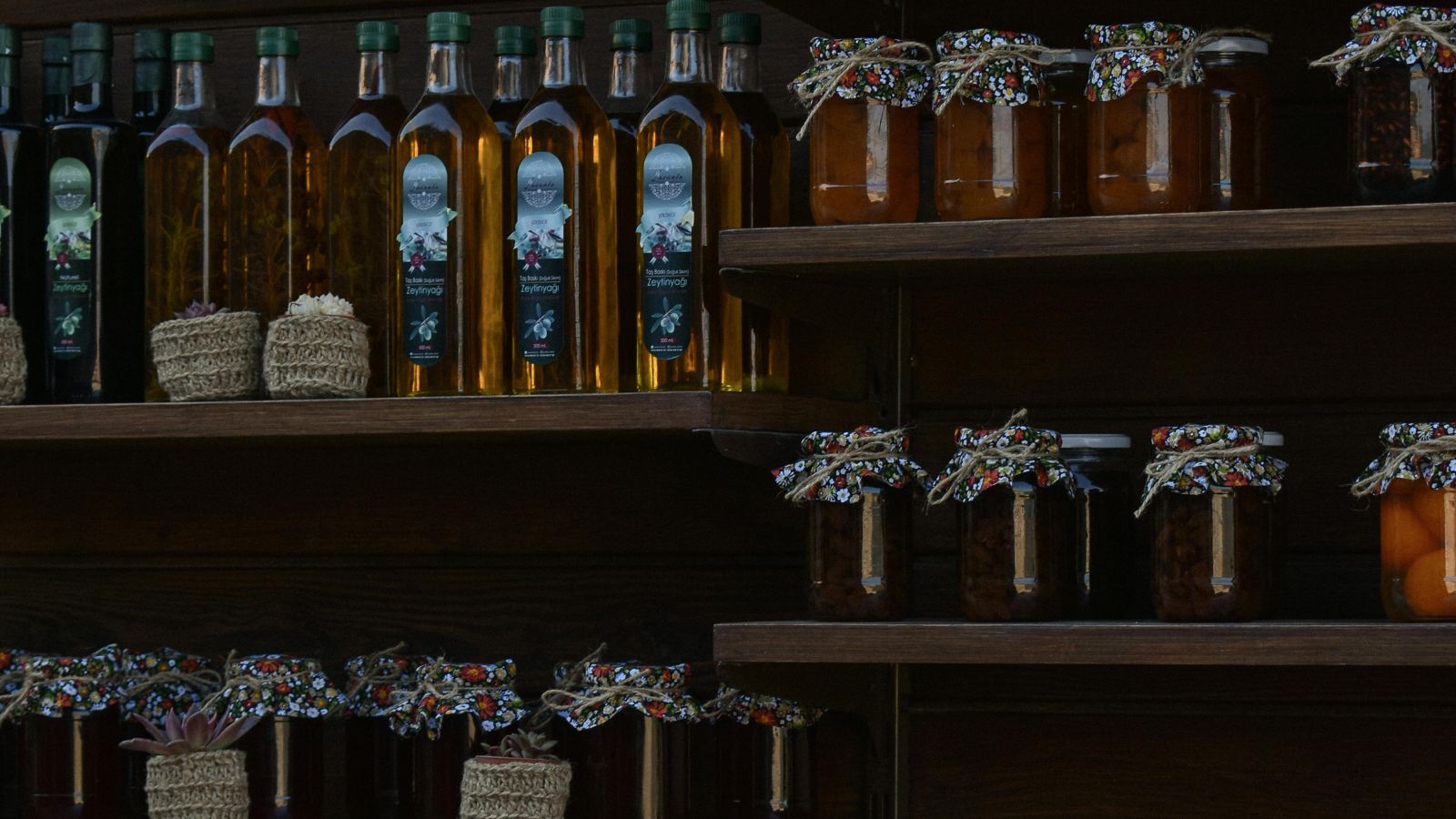
Choosing your glass food packaging: bottles, pots and jars for the food & beverage industry
For purchasing and production managers selecting glass packaging for food and beverage applications, the challenge is not limited to unit price. It is about coordinating container shape, line compatibility, regulatory compliance and supply flexibility. This guide walks through the four decision points that make the difference between a project that ramps up cleanly and one that keeps wrestling with line stops and non-conformities.
Bottles, pots or jars: which glass container for your food application?
Choosing the glass container starts with a simple question: what are you packaging, and under what conditions? A jar for an artisanal jam has little in common with a bottle for a premium olive oil or a flask for a hot sauce in mass retail. And yet, we regularly see production teams realise — too late — that the container selected at briefing stage does not match the real constraints of the filling line or of the product itself.
The glass bottle is suited to fluid to semi-fluid liquids: beverages, oils, liquid sauces, vinegars. It allows fast filling, is compatible with high-speed lines, and exists in a range of standardised necks (crown finish, 28 mm and 31.5 mm threaded finishes, ring finish) which directly drive the available closure. The pot and the jar, on the other hand, are aimed at thicker or solid products: preserves, compotes, terrines, pickles, confits. Their wide opening makes both filling and product extraction by the consumer straightforward.
But beyond shape, what should guide your selection is the container/product/process combination. Hot fill or cold fill? Pasteurisation after filling? Sterilisation in an autoclave? Each process imposes different thermal constraints on the glass. A twist-off jar intended for autoclaving must offer precise thermal and mechanical resistance, and its lid must be designed accordingly. Glass that is too thin in this context is a risk of breakage on the line — and a production stop.
Capacity also plays a key role. The 200 ml, 314 ml, 370 ml, 580 ml and 720 ml formats are widely diffused market standards, which simplifies sourcing and reduces MOQs. Atypical or bespoke formats are possible, but come with different lead times and minimum volumes. For a launch or a market test, relying on an existing catalogue format is often the most pragmatic decision.
The key points at a glance
- Bottles: fluid to semi-fluid liquids, standardised neck, compatible with high-speed lines.
- Wide pots and jars: thick, solid or preserved products, easy extraction by the consumer.
- Verify thermal compatibility: hot fill, pasteurisation, sterilisation in autoclave.
- Favour standard formats (314 ml, 370 ml, 720 ml) to reduce MOQs and lead times.
- Anticipate the closure when choosing the neck: crown, twist-off, threaded, cork.
- Validate glass thickness in line with filling process and line constraints.
|
Container type |
Typical applications |
Compatible processes |
Common closures |
|
Bottle |
Oil, vinegar, beverages, liquid sauces |
Cold or hot fill, pasteurisation |
Crown finish, 28 mm/31.5 mm thread, cork |
|
Wide pot |
Compotes, jams, honey, tapenades |
Hot fill, pasteurisation |
Twist-off TO70/TO82, press-on lid |
|
Preserve jar |
Vegetables, terrines, pickles, fruit in syrup |
Sterilisation, autoclave |
Twist-off TO63/TO82/TO100 |
|
Condiment flask |
Hot sauces, ketchup, mustard |
Cold or hot fill |
38 mm thread, pump dispensers |
The four families of glass food containers and their typical applications.
The right glass container is not the one that looks good in the photo — it is the one that runs across your line without stopping and delivers the product promise all the way to the consumer.
➜ Hesitating between several formats? Share your process constraints and our team will point you to the right container — no commitment.
Migration standards, traceability and EU regulatory compliance for glass food contact containers
Glass is one of the best-tolerated packaging materials in food contact — but that does not mean it escapes the European regulatory framework. Any purchaser or quality manager working with containers intended to come into contact with foodstuffs must ensure their supplier masters this framework and is able to provide the appropriate documentation.
The reference regulation is Regulation (EC) No 1935/2004, which sets the general requirements applicable to all materials and articles intended to come into contact with foodstuffs. It requires that such materials do not transfer their constituents to food in quantities that could endanger human health. For glass, the specific points of attention concern mainly lead and cadmium — particularly in coloured or decorated glass. Directive 84/500/EEC, amended by Directive 2005/31/EC, sets migration limits for these two heavy metals on ceramic and glass articles in contact with food.
But compliance does not stop there. If your client exports to the UK, note that the post-Brexit UK REACH framework imposes its own requirements, distinct from EU REACH since 2021. And if you work for brands positioned as organic or premium, certain retailer specifications go beyond legal obligations — no BPA in closure liners, no heavy metals in decoration inks, batch-by-batch traceability required.
On the traceability side, you must be able to trace back to the batch number and the glassmaker for each delivery. In the event of a product recall or a quality anomaly, it is this traceability that protects you — and that protects your client. A serious packaging supplier systematically provides the Declarations of Compliance (DoC) and the technical data sheets associated with each reference. If that is not the case by default, ask the question before placing an order.
Gaasch Packaging works with glassworks whose productions come with complete technical documentation: regulatory compliance declarations, material specification sheets and migration reports available on request. This level of documentation is non-negotiable for any co-packer managing food or pharma clients.
The regulatory references to know
- Regulation (EC) No 1935/2004: general framework for food contact materials.
- Directive 2005/31/EC: migration limits for lead and cadmium on glass and ceramics.
- Check compliance of decorations and printing (inks, enamels) for food contact.
- Require a Declaration of Compliance (DoC) per reference supplied.
- Anticipate UK REACH requirements when exporting to the United Kingdom.
- Batch-by-batch traceability: indispensable condition for any HACCP process or client audit.
|
Regulation |
Scope |
Glass-specific point of attention |
|
Regulation (EC) No 1935/2004 |
All EU food contact materials |
Transfer of constituents, health hazard |
|
Directive 2005/31/EC |
Glass and ceramics in food contact |
Migration limits for Pb and Cd |
|
UK REACH (post-Brexit) |
British market |
Requirements distinct from EU REACH since 2021 |
|
PPWR (Packaging and Packaging Waste Regulation) |
Packaging placed on the EU market |
Recyclability, recycled content, labelling |
|
Retailer specifications |
Mass retail, organic, premium |
Beyond legal: BPA-free, enhanced traceability |
The regulatory landscape applicable to glass food containers.
The declaration of compliance is the first thing your client will ask for if something goes wrong. Better to have it in the file before delivery, not after.
➜ Need a Declaration of Compliance for a specific glass container? Contact our quality team — we reply within 48 working hours.
Compatibility with your filling line: technical criteria to validate before any order
This is often where problems arise. A glass container can be perfect on paper — good price, attractive finish, regulatory compliant — and cause major issues from the first trial runs on line. Compatibility between container and filling line is not a technical detail to be sorted out after ordering. It is a selection criterion in its own right, and it must be validated upfront.
First point to check: the geometry of the container. External diameter, total height, finish diameter, useful fill height — these dimensions must be matched against the templates of your line: conveyors, guides, filling heads, turntables, capping systems. A few millimetres' deviation in diameter can block a conveyor or cause serial drops. Always require complete dimensional drawings in PDF or DXF format before validating a reference.
Second point: dimensional tolerance. Glassworks operate with tolerances that vary between manufacturers and blowing processes. A tolerance of ±0.5 mm on the finish diameter is acceptable for a line equipped with progressive-clamping capping heads. It can be problematic on an automatic capping line with fixed cams. Knowing the actual tolerance of the glass you order means avoiding endless line adjustments.
Third point: mechanical resistance. Glass containers undergo significant stresses on line: guide pressure, container-to-container impacts on the conveyor, capping pressure. Glass that is too thin in a large-volume format can show significant breakage rates. Conversely, glass that is too thick can cause weight problems on pallets or compatibility issues with automated gripping systems.
Finally, think about decoration if you plan a label or sleeve. The flatness of the front face, the conicity of the body, the presence of an embossed frieze — all this conditions the quality of automatic labelling. A container that is too conical can generate creases on paper or plastic labels, which translates into visual non-conformities unacceptable to your client.
At Gaasch Packaging, the technical data sheets for every catalogue reference include nominal dimensions and tolerances, the empty container weight, the fill capacity and the finish specifications — enough to feed your technical department directly without unnecessary back-and-forth.
The technical parameters to validate upfront
- Dimensions: external diameter, height, finish diameter and useful fill height to validate against drawings.
- Dimensional tolerances: to be matched against the specifications of your capping heads and conveyor guides.
- Mechanical resistance: verify glass thickness against line speed and filling process.
- Thermal resistance: indispensable for hot fill, pasteurisation or autoclave sterilisation.
- Decoration compatibility: flatness, conicity and embossing affect automatic labelling.
- Require dimensional drawings in PDF or DXF before any reference validation.
|
Technical parameter |
Impact on line |
Document to require |
|
External diameter |
Compatibility with guides and conveyors |
Dimensional drawing DXF/PDF |
|
Finish / neck diameter |
Compatibility with capping heads |
Finish technical sheet and tolerance |
|
Total height |
Adjustment of filling and capping heads |
Dimensional drawing |
|
Dimensional tolerance |
Line adjustments, reject rate |
Manufacturer tolerance specification |
|
Wall thickness |
Impact resistance, on-line breakage |
Material technical sheet |
|
Thermal resistance |
Hot fill / autoclave compatibility |
Glassmaker thermal test report |
The six technical parameters to require before validating a glass reference.
Validating a glass container on the line takes half a day. Discovering incompatibility after 10,000 units have been delivered costs a great deal more.
➜ Do you have specific line constraints? Share your technical specifications and we will identify the compatible references in our catalogue.
Supply, MOQ and stock management: what to require from your glass food packaging supplier
Managing several clients and several projects in parallel also means managing several packaging references with different life cycles. A launch starting at 2,000 units can become 50,000 units six months later — or disappear from the catalogue. In this context, the supply flexibility of your glass supplier is not a secondary advantage. It is a baseline requirement.
MOQs (minimum order quantities) vary considerably from one supplier to another. With some distributors, MOQs are aligned with glassworks' minimums — often a full pallet, sometimes several pallets per reference. That is acceptable for an established production. It becomes blocking for a 1,500-unit market test or a small batch for a specialty grocery client. A supplier who understands the reality of co-packers must be able to propose MOQs adapted to launch phases, even if it means working with shared stock or widely available catalogue formats.
Lead time reliability is the other critical variable. In production, a delay on glass packaging blocks the entire line — and potentially the commitments made to your final client. Lead times for glass supply depend on stock availability at the distributor, transport times and loading capacity. A distributor that holds stock in its own warehouse and that has its own delivery fleet offers better control of the chain than an intermediary that outsources the entire logistics.
Also think about contingency management. What happens if your need suddenly increases by 30%? If a reference is temporarily unavailable from the usual glassmaker? A solid supplier has alternatives in its portfolio and a multi-supplier sourcing network that allows it to propose a continuity solution — without leaving you to look for an alternative in an emergency.
Gaasch Packaging, active since 1906 and a member of the Packaging Alliance Europe network, relies on its own stock warehouse in Belgium and its own fleet to ensure flexible deliveries in Belgium, Luxembourg, the Netherlands, France, Germany and the United Kingdom. For co-packers managing multi-reference projects, a single point of contact (SPOC) coordinates all orders and deliveries — which avoids dispersion and communication errors when several references run in parallel.
What to require from a reliable partner
- Flexible MOQs: essential for launch phases and small client batches.
- Reliable lead times: favour a supplier with its own stock and controlled delivery fleet.
- Multi-supplier sourcing: guarantee of continuity if a reference is temporarily unavailable.
- Geographical coverage: verify lead times and delivery conditions in your active markets.
- SPOC (single point of contact): decisive time saving when managing several references in parallel.
- Stock visibility: ask for real-time access or availability confirmations before ordering.
|
Criterion |
What to require |
Supplier red flag |
|
MOQ |
Flexibility for tests < 5,000 units |
MOQ minimum 1 pallet regardless of phase |
|
Lead time |
Written commitment on standard and express lead time |
Lead times not guaranteed, dependent on third parties |
|
Stock |
Own warehouse stock on catalogue references |
100% to-order sourcing from glassmaker |
|
Sourcing |
Multi-supplier glassmaker portfolio |
Single source glassmaker, no alternative |
|
Documentation |
DoC, technical sheets available before order |
Documentation on request with lead time |
|
Contact |
Dedicated SPOC for multi-reference accounts |
Rotating contacts, ticket system only |
The six qualification criteria for a glass food packaging supplier.
The best glass supplier is not necessarily the cheapest per unit. It is the one who does not leave you stranded on the day your client needs 8,000 jars by Monday morning.
➜ Preparing a launch or a new reference? Request a quote with MOQ simulation — reply within 24 working hours.
Ready to make a move?
Looking for a reliable glass partner for your food conditioning line? Share your references or your technical constraints and receive a tailored proposal within 24 working hours. No commitment, documentation available from the first exchange.
Frequently asked questions
1. What is the difference between a twist-off jar and a press-on jar for a food application?
The twist-off jar uses a metallic lid with a helical thread: it closes by rotation and creates vacuum during cooling after hot filling or sterilisation. It is the dominant format for preserves, jams and condiments. The press-on jar (or Omnia) uses a cap that clips onto the finish by pressure and also creates vacuum thermally. Both systems are compatible with autoclaving, but the capping heads on line are not interchangeable. Compatibility between closure and line must be validated before choosing the format.
2. Which compliance documents should I require for glass containers intended for food contact in Europe?
At minimum, you must have a Declaration of Compliance (DoC) with Regulation (EC) No 1935/2004 for each reference. If the glass is coloured or decorated, a specific compliance certificate covering the lead and cadmium migration limits (Directive 2005/31/EC) is required. For UK markets, verify compliance with the post-Brexit UK framework. In practice, a serious supplier provides these documents systematically with each new referenced item, without you having to request them with every order.
3. Is it possible to order small quantities of glass containers for a market test?
Yes, provided you choose a supplier working with flexible MOQs. Glassworks themselves impose high minimums (often several pallets), but a distributor that holds stock in its own warehouse can break these volumes down and offer quantities adapted to a test — sometimes from a few hundred units on standard catalogue formats. Gaasch Packaging offers adjusted MOQs for launch phases and small batches, precisely because co-packers need to validate references before committing to large volumes.
4. How do I verify that a glass container is compatible with my hot fill process?
Hot fill requires the glass to withstand a thermal shock between the product temperature (typically 80–90 °C for jams and sauces) and ambient temperature. You must request the thermal test report of the container from the supplier, which specifies the thermal shock resistance (expressed in delta °C). Also verify that the associated closure (cap liner) is certified hot-fill compatible. A jar dimensioned for cold filling may present cracking or deformation risks in hot fill if the wall is too thin.
5. Can Gaasch Packaging supply glass food containers for markets outside Belgium?
Yes. Gaasch Packaging delivers in Belgium, Luxembourg, the Netherlands, France, Germany and the United Kingdom. The company has its own fleet for regional deliveries and relies on its Packaging Alliance Europe network for more distant markets. For co-packers operating across several markets simultaneously, a single point of contact (SPOC) coordinates multi-reference and multi-destination orders — which considerably simplifies administrative and logistical management.
6. How do I optimise MOQs for food glass when managing several clients on the same line?
When several clients run on the same line, MOQ optimisation works through three levers. First, standardisation: converge your clients as much as possible towards shared catalogue formats (314 ml, 370 ml, 720 ml) — a single stock then serves several projects. Next, stock mutualisation at your distributor: negotiate a dedicated stock or consignment stock arrangement that allows you to draw in smaller tranches while guaranteeing overall supply. Finally, rolling planning: a rolling forecast shared with your supplier allows upstream adjustment of glassworks orders and reduces overstock. A partner like Gaasch Packaging can combine these three levers via a SPOC consolidating the multi-client view.
7. What are the main mechanical constraints to anticipate on a high-speed glass food filling line?
On a high-speed line, the most critical mechanical stress zones for glass containers are: the neck and shoulder (gripping zones by guides and transfer stars, subject to glass-glass or glass-stainless steel impacts); the bottom (resting on belt or chain conveyors, with the risk of micro-cracks if the bottom is irregular or the container is subjected to repeated vibrations); and the lateral wall in the contact zones with pushers and centring guides. Internal pressure resistance is also critical for hot fillings or carbonated products. These parameters must appear on the container's technical data sheet (internal pressure resistance in bar, lateral impact resistance in J). It is advisable to request resistance curves from glass manufacturers to compare references in real conditions.
8. Which technical documents should a food glass supplier systematically provide with every delivery?
For every delivery of glass containers for food use, your supplier must be able to provide the following documents: the food contact declaration of compliance (DoC) in line with Regulation (EC) No 1935/2004, the dimensional technical sheet (with tolerances) and weight specifications of the container, the batch analysis or test certificate if specific tests were requested, and the delivery note with batch identification enabling traceability. In the case of decorated glass (lacquered, screen-printed, sleeved), additional documents relating to inks and coatings in indirect contact may be required depending on your application. The quality of the documentation provided with every delivery is a direct indicator of the supplier's quality maturity level and of its ability to support you in the event of a client audit or regulatory inspection.
9. How does Gaasch Packaging support purchasing and production managers in selecting and sourcing their glass food packaging?
Gaasch Packaging supports its clients with a technical-partnership logic, not just a commercial one. In concrete terms, this translates into: an initial diagnostic of line constraints and product specifications before any reference recommendation; access to a multi-glassworks range that allows several options to be compared without commercial bias; systematic provision of technical and regulatory documentation (DoC, technical sheets, dimensional drawings); MOQs adapted to launch phases and small batches; and a single point of contact (SPOC) who follows the entire dossier — from initial quote to recurring delivery. For multi-reference accounts, this SPOC model significantly reduces the administrative load on the client side and ensures consistency of commitments across all projects.
10. What are the decisive criteria for choosing between glass packaging and PET plastic packaging for a food product?
The choice between glass and PET for food packaging rests on a multi-criteria analysis that must integrate: the nature of the product (sensitivity to oxygen, acidity, viscosity, organoleptic requirements — glass offering superior chemical inertness); the filling process and thermal constraints (glass is compatible with high-temperature hot fills, unlike standard PET); the regulatory requirements of your market (certain premium or organic segments value glass for perception and compliance reasons); the logistical balance (weight, fragility, breakage rate, transport cost); and sustainability objectives (recyclability, recycled content, PPWR). There is no universal answer: the optimal decision results from an analysis of your product, your line and your target market, ideally conducted with a supplier capable of sourcing both types of containers and supporting you in the comparison without commercial bias.